

African penguins are predicted to be extinct in the wild by 2035. That’s not a distant, abstract statistic. And it’s why, this summer, two members of the Denver Zoo Conservation Alliance team boarded a flight to Cape Town, South Africa to help do something about it.
Registered Veterinary Technician Jessy and Lead Bird Care Specialist Heather spent two weeks at SANCCOB: the Southern African Foundation for the Conservation of Coastal Birds, a seabird rehabilitation center that has been pushed to its limits this year by a surge of abandoned penguin eggs and chicks following record heat waves and storms along South Africa’s coast.
Why SANCCOB Needed Help
Cape Town has experienced some of its most intense weather events in recent memory this year. Extreme heat waves and powerful storms have caused African penguins to abandon their eggs and chicks at alarming rates, leaving SANCCOB to take in whatever comes through their doors.
This year alone, SANCCOB received more than 500 abandoned eggs. With each one representing a potential life for a species teetering on the edge, the center needed all the help it could get.
“SANCCOB has been taking in every abandoned penguin chick and egg,” Jessy explained. “Because of that, they needed a lot of extra help, and we were able to go and provide our expertise as zoo professionals to help care for the penguins there at the rehabilitation center.”
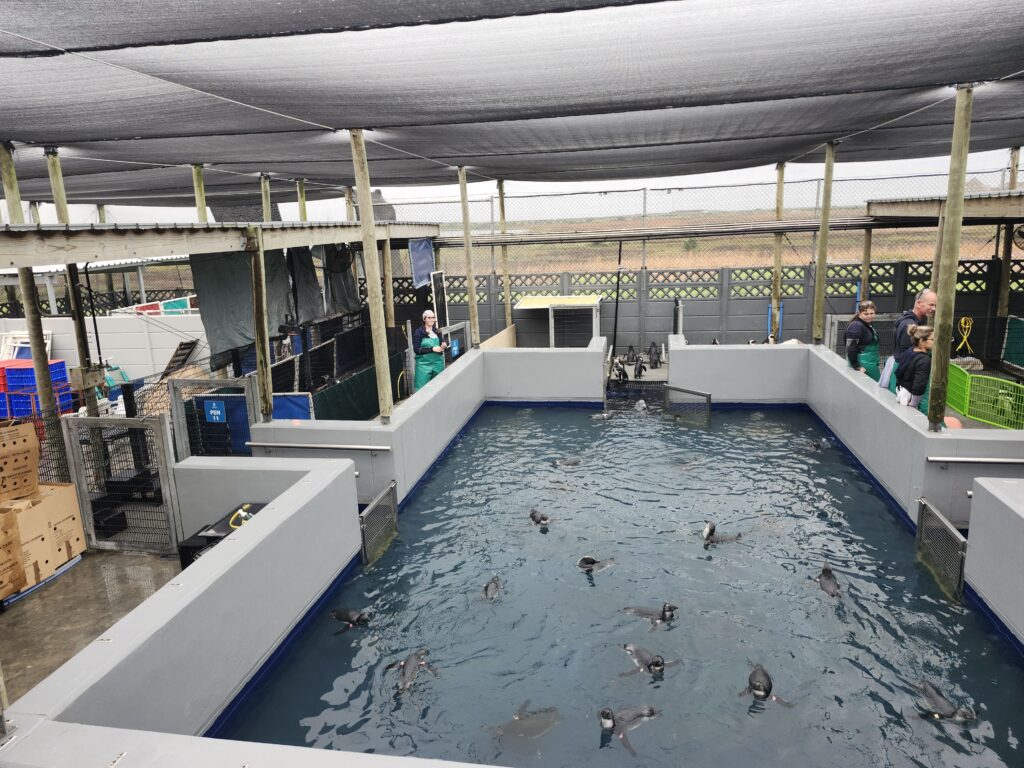


Two Weeks, Up to 100 Birds a Day
Jessy and Heather arrived at SANCCOB and got straight to work. Their days were full.
“We worked in the rehab pens with some older chicks, as well as the chick rehab pens with some younger ones,” Heather described. “Daily life included fish prep, feeding twice a day. Some birds got medications that we were also administering. Some birds had different needsabout how much time they needed to swim in the pool. Usually, in a day, the two of us would have 50 to 100 birds under our care.”
Busy days is an understatement. But for two professionals who spend their careers caring for animals, it was exactly the kind of work they’d trained for.

The Release
Both Jessy and Heather agree on the most memorable moment of the trip: around 40 of the birds they had been caring for were approved for release into the wild.
“We got to drive them out to a protected penguin colony in Stony Point, South Africa, and release them into the wild,” Jessy said. “It was some of their first time even seeing sand or the ocean, so they weren’t really sure what was going on. But it was really fun to see where they started when we were there and kind of have that full circle moment of watching them swim out into the ocean for the first time and go be a wild penguin.”
For Heather, the release was the most memorable part of the entire experience, not just for the penguins, but for the people surrounding them.
“We also got to spend time with the rangers at that park and hear about everything they do there,” she said. “How they monitor the colony, how they keep an eye out for predators and different weather events, all the different things they had to take care of with the penguins at those wild colonies.”
Nearly 100 penguins were released during their two weeks at SANCCOB. Every single one of them counts.


Science, Community, Action
Our Conservation Strategic Framework reflects DZCA’s commitment to taking action, developing expertise, and creating lasting impact across our conservation focus areas. We leverage our collective expertise and resources to care for and protect wildlife and respond where we can help.
For Jessy, whose primary role at DZCA is in the hospital, the experience opened up a new dimension of her penguin care skills. The expertise gained in hands-on restraint, high-volume care, and navigating the daily demands of a busy rehabilitation center came straight back to the work here on campus.
And the timing couldn’t have been more meaningful. Shortly after returning home, Jessy’s first patient was Lucy, our own African penguin who was hospitalized for about a month with a suspected anaphylactic reaction.
“Having the experience of taking care of so many penguins at SANCCOB made it so that I had better penguin handling skills, and I was able to do a lot of her treatments by myself which freed up other veterinary technicians and veterinarians to go work with other animals throughout the Zoo and increase our capacity for care.”
For Heather, the trip reinforced something deeper.
“It was really amazing to get to care for wild penguins. I got to use the expertise I use here every day when I take care of our penguin flock and use that there to help out SANCCOB. And it was really beneficial coming back and being able to have that experience of seeing those wild penguins, and knowing why we do this here at DZCA.”
How You Can Help
The connection between the penguins at African Penguin Point and the wild birds on the shores of South Africa is real, and your visit to DZCA helps support it.
African penguins are predicted to be extinct in the wild by 2035. But work like Jessy and Heather’s remind us that extinction isn’t inevitable, not when people show up, roll up their sleeves, and get to work.


